%20(1).png)
Weight loss may dominate the conversation around GLP-1 medications, but employers are increasingly focused on a different question: can these medications help change the trajectory of chronic disease before high-cost conditions develop?
At the inaugural eMed Health Innovation Revolution Summit, employers, clinicians, researchers, and benefits leaders focused less on pounds lost and more on the impact of addressing chronic disease risk earlier. The discussion wasn't centered on whether GLP-1 medications work. The science on that question continues to grow. Instead, the conversation focused on a larger opportunity: can employers use these medications as part of a long-term strategy to support population health strategies and help address chronic disease risk?
For decades, employer-sponsored healthcare has largely been reactive. An employee develops diabetes. Treatment begins. Cardiovascular risk factors worsen. Intervention follows. Musculoskeletal issues emerge. Healthcare utilization increases. By the time many conditions are treated, the costs have already begun to accumulate.
What made this year's summit particularly interesting was the growing recognition that employers may have an opportunity to intervene earlier. Not simply to manage conditions once they become expensive, but to help change the long-term health trajectory of their populations before high-cost events occur.
The Cost Curve Starts Long Before the Claim
Healthcare costs rarely appear overnight.
The hospitalization, emergency room visit, or complex diagnosis that ultimately drives spending is often the result of years of underlying risk factors progressing over time. Obesity, diabetes, cardiovascular disease, and other chronic conditions don't just impact employee health. They influence healthcare utilization, productivity, absenteeism, and long-term benefit costs.
This reality was reflected in data shared throughout the summit.
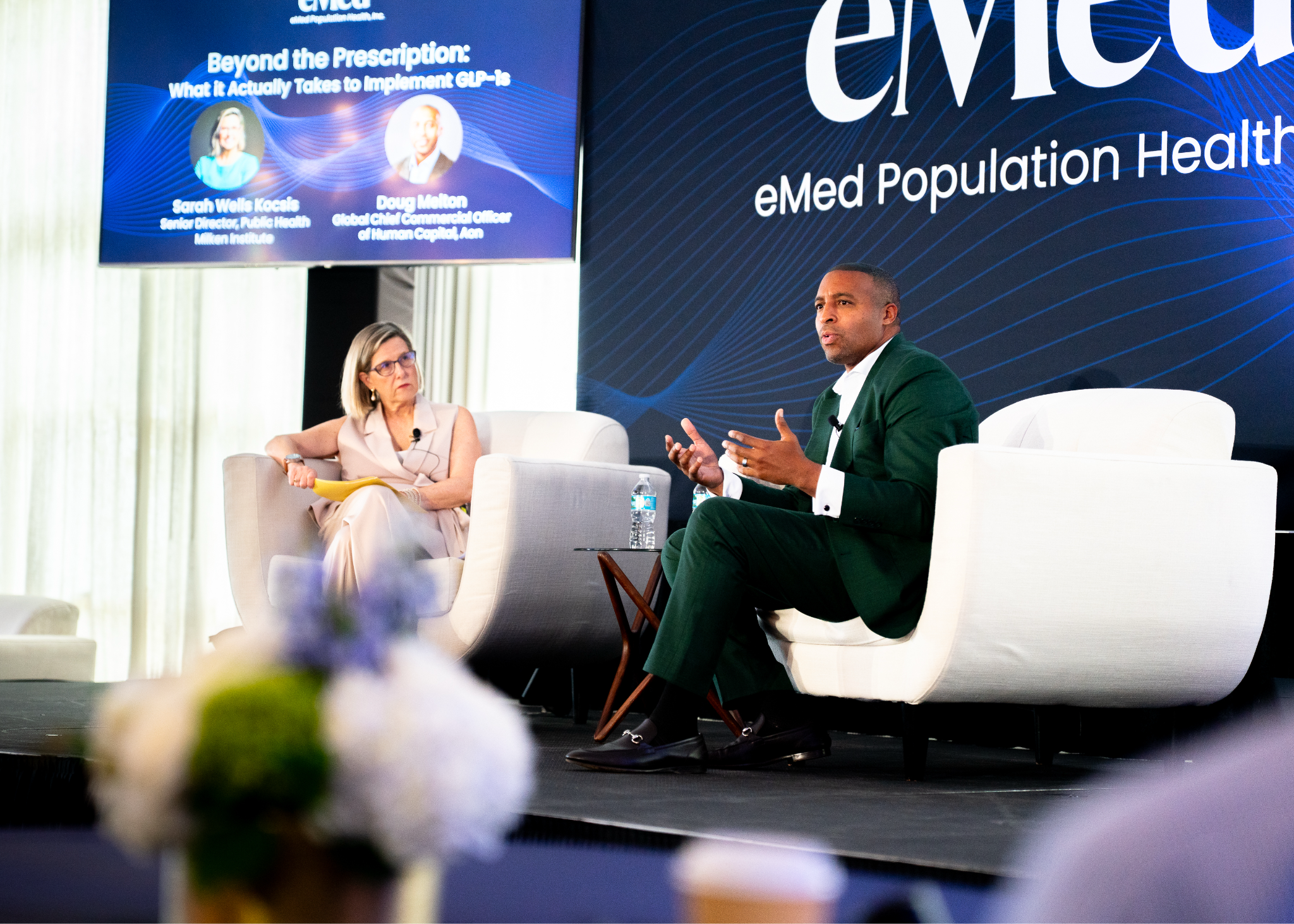
Doug Melton of Aon highlighted findings showing that employers achieving adherence rates between 50% and 70% experienced approximately a 3% reduction in healthcare costs. At 80% adherence, healthcare costs declined by roughly 7%. The impact extended beyond cost alone. After 12 months, hospitalization rates were reported to be 37% lower among participants who remained engaged in treatment programs.
Those statistics are significant, but perhaps not for the reason many people assume. They aren't simply adherence metrics, they're indicators that long-term health outcomes can change when employees receive the support needed to stay engaged in care.
Prevention Requires More Than Access
One of the strongest themes throughout the summit was the idea that prevention cannot be achieved through coverage alone.
Historically, healthcare benefits have often been measured by access. Is a service covered? Can employees obtain treatment? Are medications available?
Those questions remain important, but they represent only the starting point.
As Dr. Scott Kahan noted during the summit, "It's not enough to just cover these medications. People need support, myth-busting, and ongoing care."
That observation reflects a broader challenge facing healthcare. Starting treatment is one thing. Remaining engaged long enough to experience meaningful health improvements is another.
Patients often need guidance beyond the prescription itself. Questions about nutrition and lifestyle changes, side effects, online misinformation, and periods of slower progress can all affect engagement. Without support, even clinically appropriate interventions may not deliver their intended impact..
The same principle applies across nearly every area of healthcare. Prevention is not a single event. It is an ongoing process that requires participation, engagement, and consistent clinical support.
The Employer Perspective Is Evolving
Perhaps the most notable shift discussed at the summit was how employers are evaluating success. A few years ago, many organizations were focused primarily on utilization and budget impact. Today, the conversation is becoming more sophisticated.
Employers are increasingly asking:
- Are employees staying engaged in care?
- Are health risks improving over time?
- Are healthcare utilization patterns changing?
- What do outcomes look like after one year, two years, or three years?
- How should long-term value be measured?
These questions signal a transition from managing benefits to managing population health.
Employers are recognizing that the goal is not simply to provide access to healthcare services. The goal is to create conditions that support better health outcomes over time.
That distinction matters because healthcare outcomes rarely follow quarterly reporting cycles. Many of the benefits associated with chronic disease prevention emerge gradually. Meaningful reductions in healthcare utilization, complications, and downstream costs often take years to fully materialize.
Why the Long-Term View Matters
One comment from the summit captured this reality particularly well. Christian Davi of Aon noted that employers already covering GLP-1 medications should think carefully about protecting that investment through adherence and engagement strategies.
His point speaks to a broader challenge facing employers today. Benefits decisions are often evaluated annually. Population health outcomes are measured over much longer periods. That creates tension between short-term budgets and long-term value.
Yet many of the outcomes employers ultimately care about, including reduced hospitalizations, improved health status, lower healthcare utilization, and reduced chronic disease burden, are only achieved when individuals remain engaged in care over time.
As Doug Melton emphasized during the summit, the most meaningful changes in healthcare costs often become increasingly visible in years two and three. In other words, the conversation may be less about immediate savings and more about changing future trajectories.

A New Way to Think About Population Health
The most important takeaway from the eMed Health Innovation Revolution Summit wasn't a statistic, a medication, or a single program model, it’s the growing recognition that employer health strategies are evolving.
For years, organizations have focused on responding to chronic disease after it becomes costly. Increasingly, employers are exploring how to intervene earlier, support employees more effectively, and create conditions that improve long-term outcomes.
The future of population health may not be defined by treating illness once it occurs. It may be defined by preventing costly complications before they happen. That requires a different mindset. One that prioritizes long-term engagement over short-term utilization, outcomes over access alone, and prevention over reaction.
The conversations at this year's summit suggested that many employers are already beginning to make that shift. And if the data shared throughout the day is any indication, the organizations that do may be the ones best positioned to improve both employee health and healthcare costs in the years ahead.
The conversation around GLP-1s is evolving. See how the eMed GLP-1 program helps employers support long-term health outcomes while addressing the burden of chronic disease. Learn more
Disclaimer: This blog is maintained by eMed for informational purposes only. Content published here does not constitute medical, legal, financial, or benefits advice and should not be relied upon as such. Third-party statistics, studies, and research cited are sourced from publicly available data and provided for general informational context only; eMed makes no representation as to their accuracy, completeness, or applicability to any specific employer population, and results may vary. eMed's GLP-1 program pairs FDA-approved, on-label medications with clinical oversight; individual health outcomes depend on a variety of clinical and personal factors and cannot be guaranteed. Statements, quotes, and data attributed to summit speakers or other third parties are their own and do not necessarily represent the views of eMed, and eMed does not endorse any third party. Any cost, savings, or utilization figures reflect third-party data and are not a prediction or guarantee of results from eMed’s program.
Any content authored or posted by eMed employees reflects their personal opinions and perspectives only and does not represent the views, positions, or official statements of eMed or its affiliates.
.jpg)
.jpg)
.jpg)
